Classic Literature
Don Quixote
The most famous novel in the world, and most people don’t read it until college, if they read it at all. An old man reads too many adventure books, straps on rusty armor, and charges a windmill. He’s ridiculous and noble at the same time, wrong about everything and right about the thing that matters most. Cervantes wrote the first character like that, and every story since owes something to what he figured out.
Why we love it
- A guy reads so many adventure books he wakes up one day, straps on rusty armor, and decides he is officially a knight.
- He charges a windmill dead certain it is a giant, gets flattened, and gets right back up without a flicker of doubt.
- It is the rare hero who is wrong about absolutely everything and still somehow braver than everyone laughing at him.
- Watch the practical friend Sancho roll his eyes the whole way and then quietly start believing too, by a campfire, out loud.
Why it matters
Don Quixote, published by Miguel de Cervantes in two parts (1605 and 1615), is widely called the first modern novel and, by many counts, the greatest ever written. It has been translated into more than sixty languages, and its two figures, the deluded knight and his plain-spoken squire Sancho Panza, are recognized by more readers than almost any other invented characters in the world. Cervantes built something new here: a long story that holds many voices and points of view at once, the form nearly every novel since has been written inside. It is still read four centuries later because the central question, how far to follow a beautiful idea that the facts keep contradicting, never stops being current.
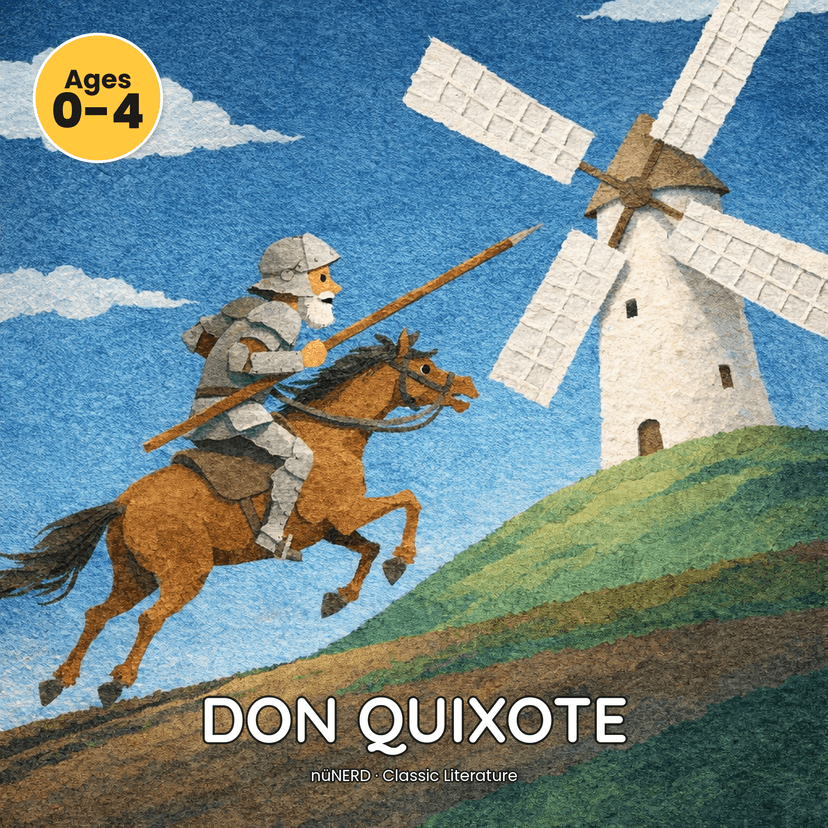
Ages 0–4 · Read TO
Don Quixote
Picture Book (8.5" × 8.5") · Full Color Cut-Paper Collage
A skinny horse, rusty armor, and a windmill that wins. An old man reads so many books about knights that one morning he says “I am one.” He charges a windmill, gets knocked down, and gets right back up. Then he meets Sancho Panza, and by the last page, Sancho is seeing castles too.
Buy on Amazon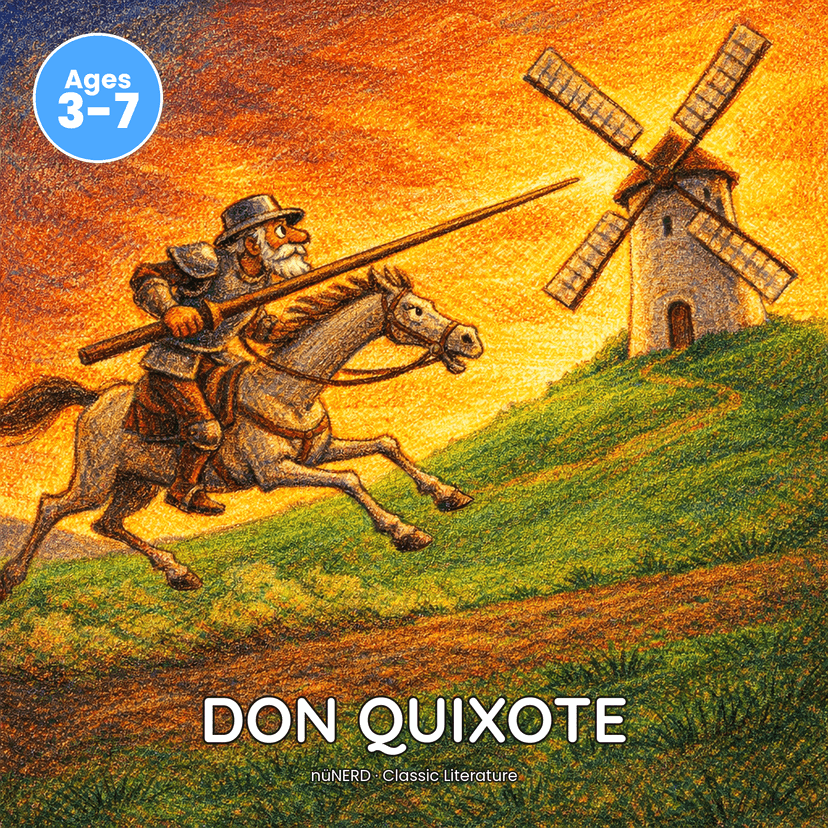
Ages 3–7 · Read WITH
Don Quixote
Picture Book (8.5" × 8.5") · Full Color Soft Crayon
Seven real episodes from the novel, not just the windmills. A caged lion that yawns and lies back down. A puppet show destroyed mid-rescue. A barber’s basin seized as a golden helmet. And by a campfire, Sancho asks “Do you really believe all this?” The comedy and the sincerity live in the same story.
Buy on Amazon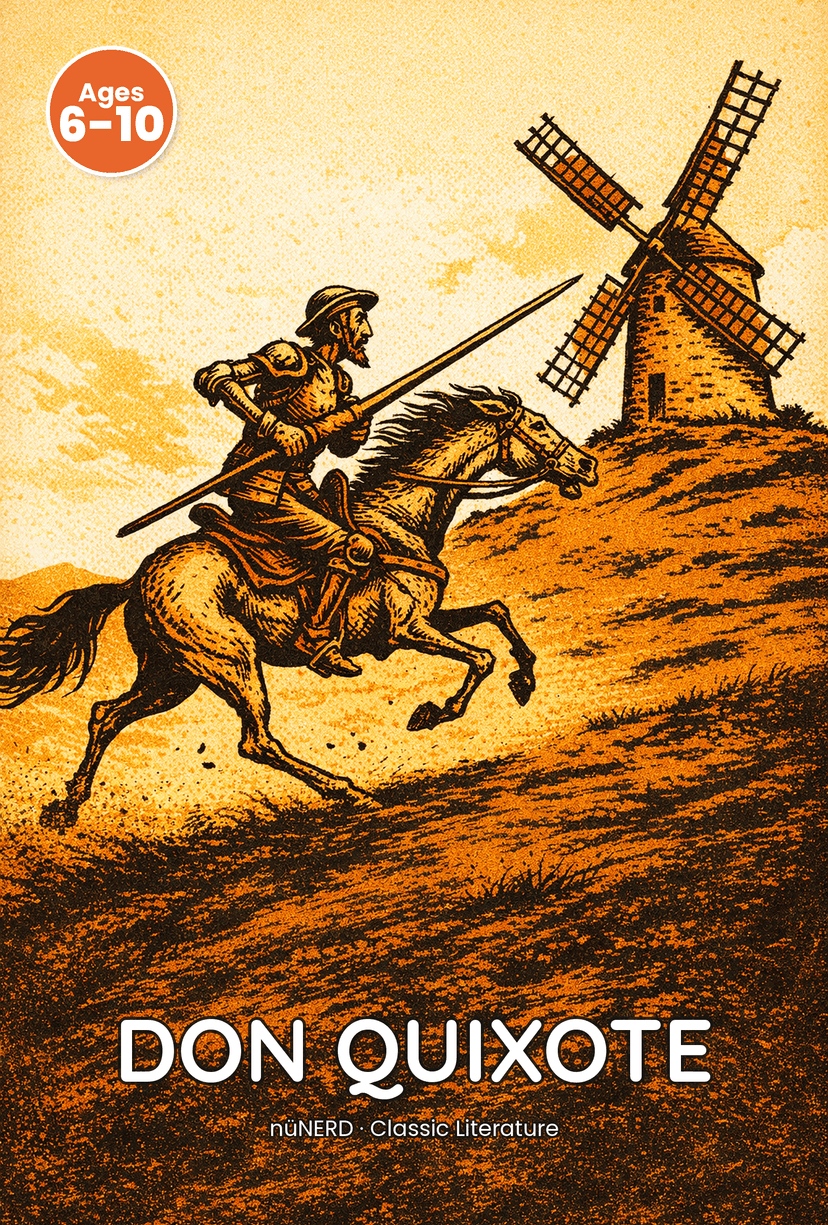
Ages 6–10 · Early Independent
Don Quixote
Chapter Book (6" × 9") · Black & White Illustrations
The complete novel retold. A Duke and Duchess who invite Don Quixote to their castle just to humiliate him. Sancho who confronts them. A duel on a beach that forces the knight home. And an ending where belief breaks, Sancho holds his hand, and the question Cervantes left open four centuries ago lands on your child.
Buy on AmazonFree resources
Read Don Quixote free
Our books are built to get kids ready for the real thing. When they are, here is the real thing, free: the public-domain text, a volunteer-read audiobook, and background worth a parent’s time.
Watch and explore
- Why should you read Don Quixote? (TED-Ed)
A short animated lesson on the knight, his squire, and what keeps readers coming back after four centuries.
Background for parents
- Don Quixote (Britannica)
A trustworthy overview of Cervantes' two-part novel and why it is often called the first modern novel.
Go deeper
- Picturing Don Quixote (The Public Domain Review)
A richly illustrated essay on how artists across the centuries pictured the knight, including Gustave Dore.
Read and listen free
- Don Quixote (Project Gutenberg)
The complete novel, free in the classic Ormsby translation, both parts start to finish.
- Don Quixote (LibriVox audiobook)
A free full-length recording of both parts, good for a long drive or listening along with the text.
Read more
Why We Made Don Quixote for Kids (at Every Reading Level)
Don Quixote is one of the great novels, and most people never meet it until college. Here is why we adapted it for children, what age it is really for, and how to read it aloud.
Read the post