July 6, 2026
Why We Made Ulysses for Kids (Yes, That Ulysses)
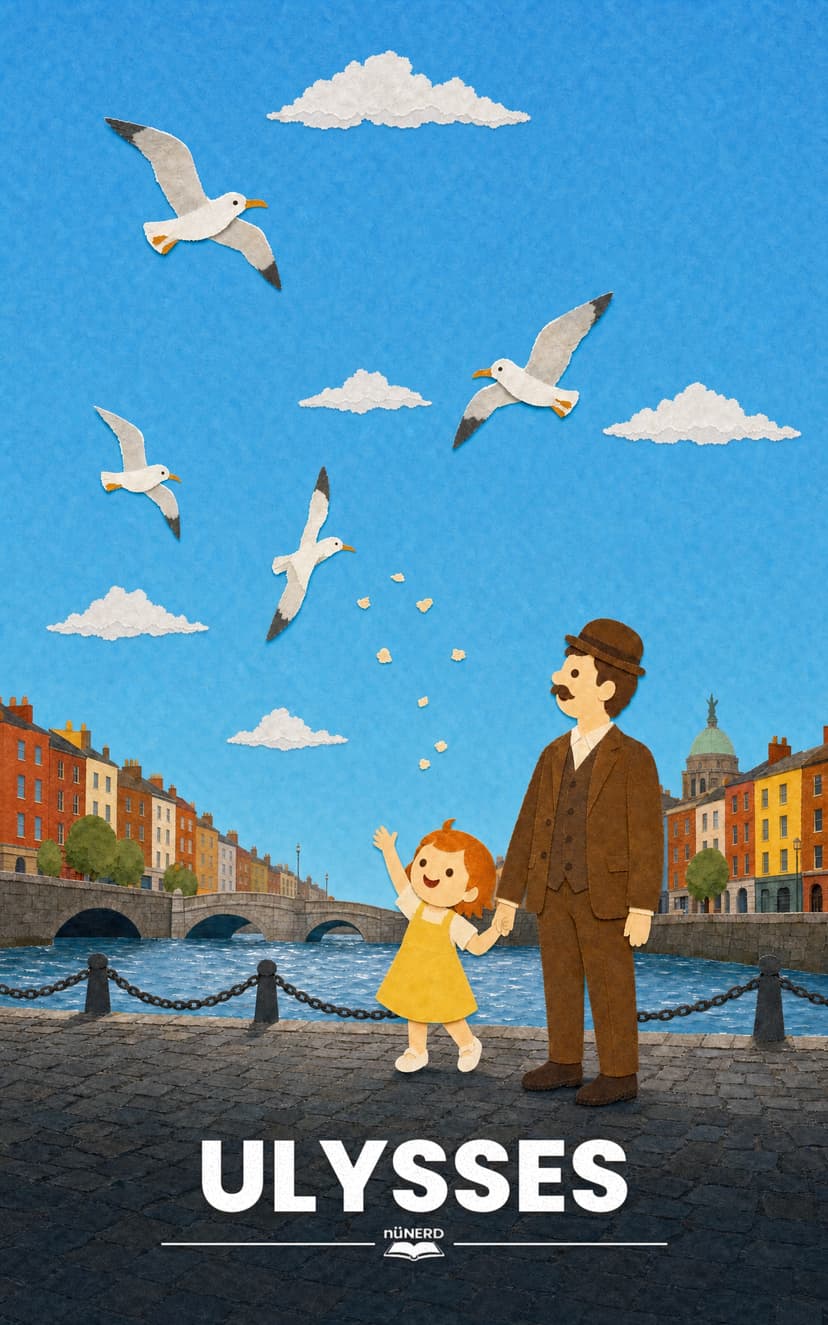
Yes, Ulysses works for kids, and the reason is hiding in plain sight. Strip away the novel's famous difficulty and what remains is a story a child understands immediately: one kind man spends one whole day walking around his city, noticing things, and helping people, and then he goes home to bed. James Joyce's dare was that such a day, watched closely enough, holds as much wonder as a hero's ten-year voyage. Children make that bet every single day of their lives. We built Ulysses at three reading levels, from a toddler book a two-year-old can hear to a chapter book a ten-year-old can read alone, so a child can feel Joyce's wager years before anyone tells them this book is supposed to be hard.
Is Ulysses appropriate for children?
The original is not a children's book, and we will not pretend otherwise. It is enormous, twisting, written for grown-ups, and famously earthy in places; it was banned in more than one country before courts and readers came around. That is exactly why every children's Ulysses must be an adaptation rather than an abridgment, and why a good one keeps the day and its kindness rather than the difficulty. Our youngest book gives the day to a small girl: the cat that says mrkgnao, a little cake of lemon soap, gulls catching bread in the air, fireworks over the bay, and a goodnight that ends, like the novel, on yes. Our picture book follows kind Mr. Bloom from breakfast to bedtime. Our chapter book tells the whole day and then, in an honest afterword, tells your child the rest: the banning, the Bloomsday holiday, and the Odyssey hidden inside.
What age should kids read Ulysses?
Far younger than the usual answer, which is "college, if ever." The trick is matching the book to the child rather than the child to the book. A two-year-old can hold the shape of it: one day, one city, morning to night. A five-year-old can follow Mr. Bloom's day and feel the story's real spine, which is kindness under pressure. A nine-year-old can read the complete day and meet the idea that made the novel famous: that an ordinary person, noticed closely, is a quiet kind of hero. Our Ulysses editions run across ages 0 to 10, so a household can meet the same day together.
What is Ulysses about, in simple terms?
One ordinary man, one ordinary day. Mr. Leopold Bloom wakes in Dublin on the sixteenth of June, 1904, feeds his cat, brings his wife Molly her tea, and goes out into the city. He buys a bar of lemon soap. He feeds the gulls. He stands with mourners at a funeral. He keeps his temper when a loud man tells him he does not belong. And when night falls he finds a lost young man named Stephen, tired and far from home, and walks him safely there before finding his own way back to Molly. Joyce shaped the whole day quietly on Homer's Odyssey, the ancient poem about the hero the Romans called Ulysses, which is where the novel gets its name.
Why does Ulysses still matter?
Published in 1922, Ulysses is routinely named the greatest novel of the twentieth century, and it changed what novels are allowed to do: it treats a single ordinary day as a subject worthy of an epic, and it follows a mind as closely as other books follow a sword. It is also the rare novel with its own holiday. Every year on June 16, readers in Dublin and around the world dress up, retrace Mr. Bloom's route, and call it Bloomsday. A book that grown-ups once banned became a book the world throws a party for. A child who meets Mr. Bloom early inherits all of that at the root: the noticing, the kindness, and the conviction that ordinary days are worth paying attention to.
How do you read Ulysses with kids?
Read it as a noticing game. The books are built around small things seen closely, a cat, a song through a window, a stranger who needs an arm, so pause and let your child spot what Mr. Bloom would spot. Let the quiet beats sit: the pub scene where staying gentle costs more than shouting would, the lamplit walk home. And you have a ready-made family holiday: on June 16, have breakfast together, take one long walk through your own town, and notice everything, which is all Bloomsday really is. One caution for the curious: the free LibriVox recording of the original novel is, like the novel, bawdy in places, so save it for the grown-ups. All the free resources, with notes on which are for parents and which are for kids, are on our Ulysses page.
That is why we made Ulysses for kids at every reading level, rather than one book leveled up and down. You can see all three editions, plus the free text, background, and Bloomsday resources, on the Ulysses page.
The books
Ulysses on Amazon
Frequently asked questions
How long are the Ulysses books, and what format is each one?
There are three. The ages 0-4 toddler book is a short read-aloud that gives Joyce's day to a small girl, morning to goodnight. The ages 3-7 picture book follows Mr. Bloom's whole day of small kindnesses. The ages 6-10 chapter book tells the complete day at about 7,400 words, with a foreword on Joyce's dare and an afterword on Bloomsday, the banning, and the Odyssey hidden inside.
Is Ulysses too adult for children?
The original novel is for adults, and parts of it are famously earthy. Our editions are adaptations built for children, not abridgments of the adult text: they keep the day, the city, and the kindness, and leave the grown-up material behind. The chapter book's afterword is honest with kids that the real book is enormous and difficult and waiting for them someday.
What is Bloomsday, and can families celebrate it?
Bloomsday is June 16, the single day in 1904 on which Ulysses is set. Every year, readers in Dublin and worldwide retrace Mr. Bloom's route through the city. A family version is simple: breakfast together, one long walk through your own town, and a game of noticing everything, which is the heart of the novel anyway.
Where can I read or hear the original Ulysses for free?
The novel is public domain. The complete text is free on Project Gutenberg, and a free volunteer LibriVox audiobook exists, though like the novel it is bawdy in places and is for grown-ups rather than read-alouds. Both are linked from the Ulysses page, along with a TED-Ed case for the book and Bloomsday background from the James Joyce Centre in Dublin.
Free printable pack
Read Plutarch with your kids
The free Plutarch family pack gives you the 25-pair Parallel Lives wall map, a parent’s guide to starting Plutarch years before a curriculum does, and a four-level sampler of Alexander & Caesar. A printable PDF you can use tonight.
Get the free pack